Ángela Leyva
What a Portrait Leaves Out
Working from a clinical archive and paintings she made from it, the Mexico City artist describes the decisions that let a face come into focus, merge with its surroundings or stay out of view.
Read the conversation
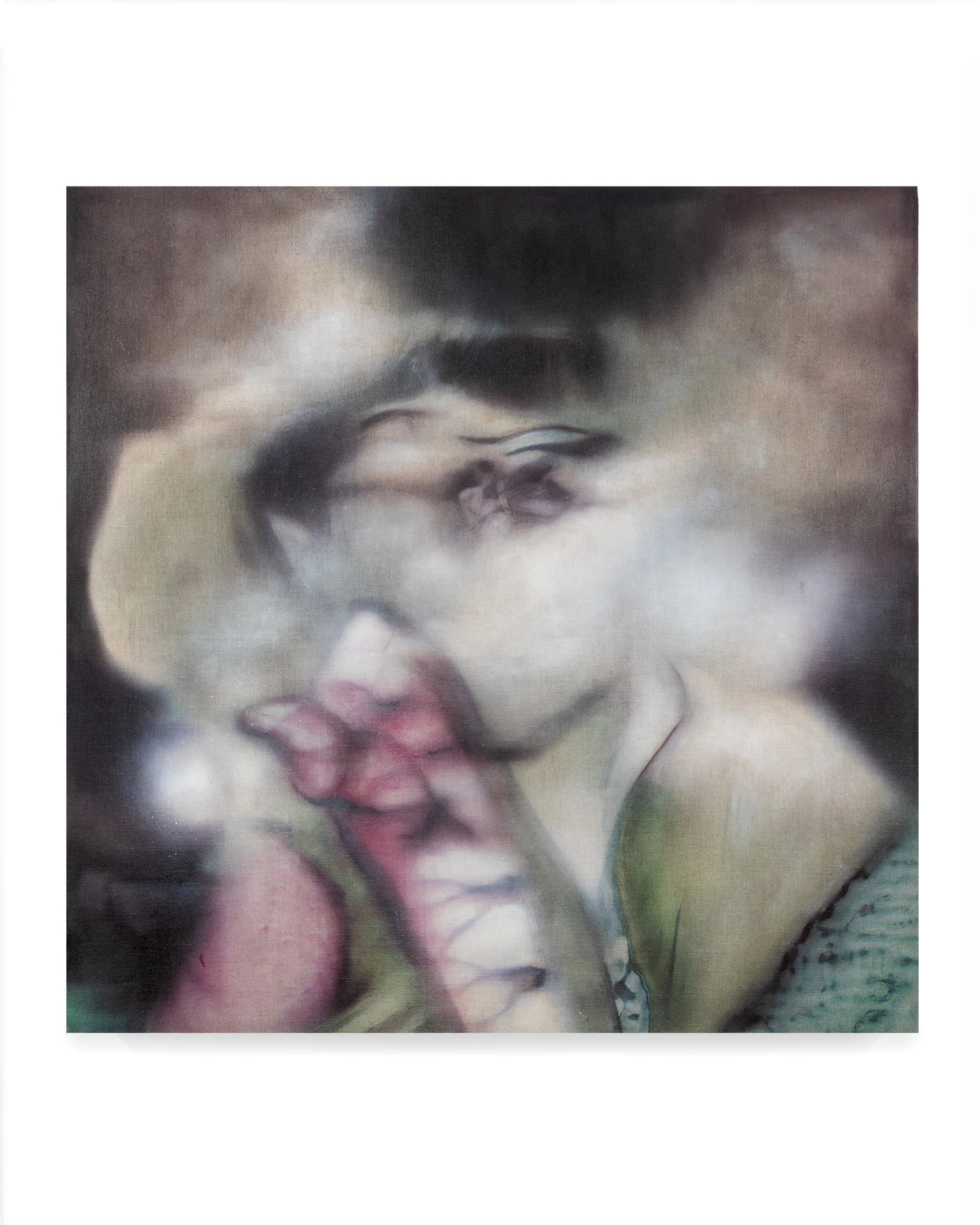
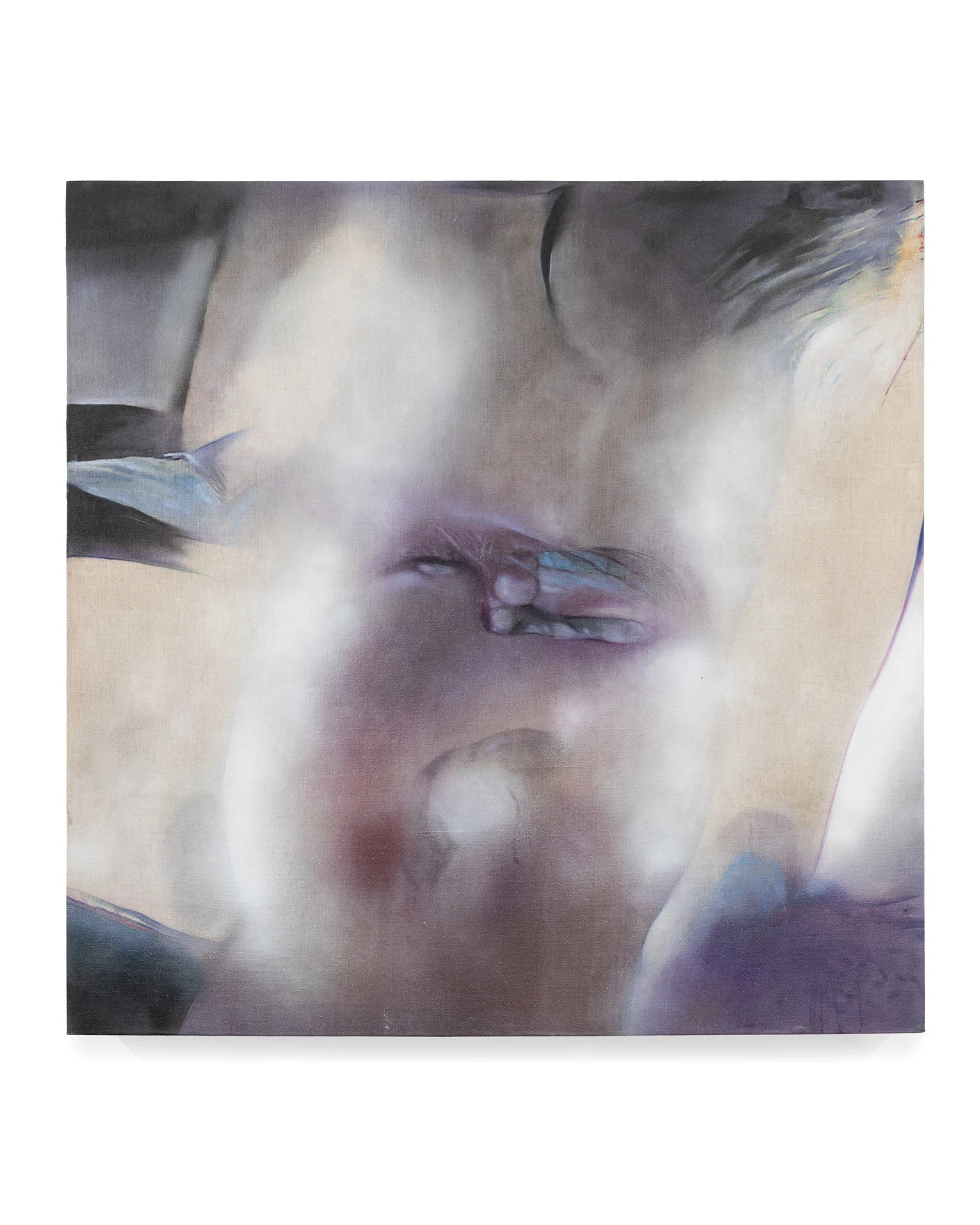
In Ángela Leyva’s painting GAN 7, a face emerges more clearly in some places than in others. Leyva worked in glazes, changing the colour until parts of the face began to merge with the ground. At CURRO in Guadalajara, the painting hung inside an open cube. You could walk around it and see its edge even where the face itself was hard to locate. The digital sketch behind GAN 7 drew on two archives: clinical photographs assembled by Leyva’s father, a medical geneticist, and paintings she had made from those photographs for her series Bilis Negra. Working with artist Fabiola Larios, Leyva brought the two sets of images together. Here she describes what she kept out of the frame, what she changed in oil and how it feels to approach a painting when the ground beneath your feet dictates where you can stand.
For Encarnación at CURRO, could you choose one painting and describe the first substantial change you made to the generated image it came from? What made you decide that change needed to happen in paint?
Ángela LeyvaFor Máquinas que sueñan niños, I used generative adversarial networks (GANs) to bring two archives together: my father’s clinical archive and my own archive of paintings from Bilis Negra. The resulting images served as sketches rather than models to reproduce faithfully.
In GAN 7 (2024, oil on linen, 120 × 120 cm), I was interested in the relationship between the face and the atmosphere around it. Through glazes and shifts in colour, some areas became more sharply defined, while others stayed diffuse or began to merge with the background. Painting allowed me to work on that relationship without having to resolve the image completely.
Moving onto canvas involves decisions that aren’t contained in the digital sketch. Oil paint has its own timing, its own resistance and its own material possibilities. I had no interest in correcting or repeating the distortions the machine produced. I wanted to start from them and follow the course of the painting itself, allowing it to take a direction I hadn’t determined in advance.
In Encarnación, the paintings are suspended inside an open cubic structure. What can a visitor understand by moving through it that a photograph taken straight on would leave out?
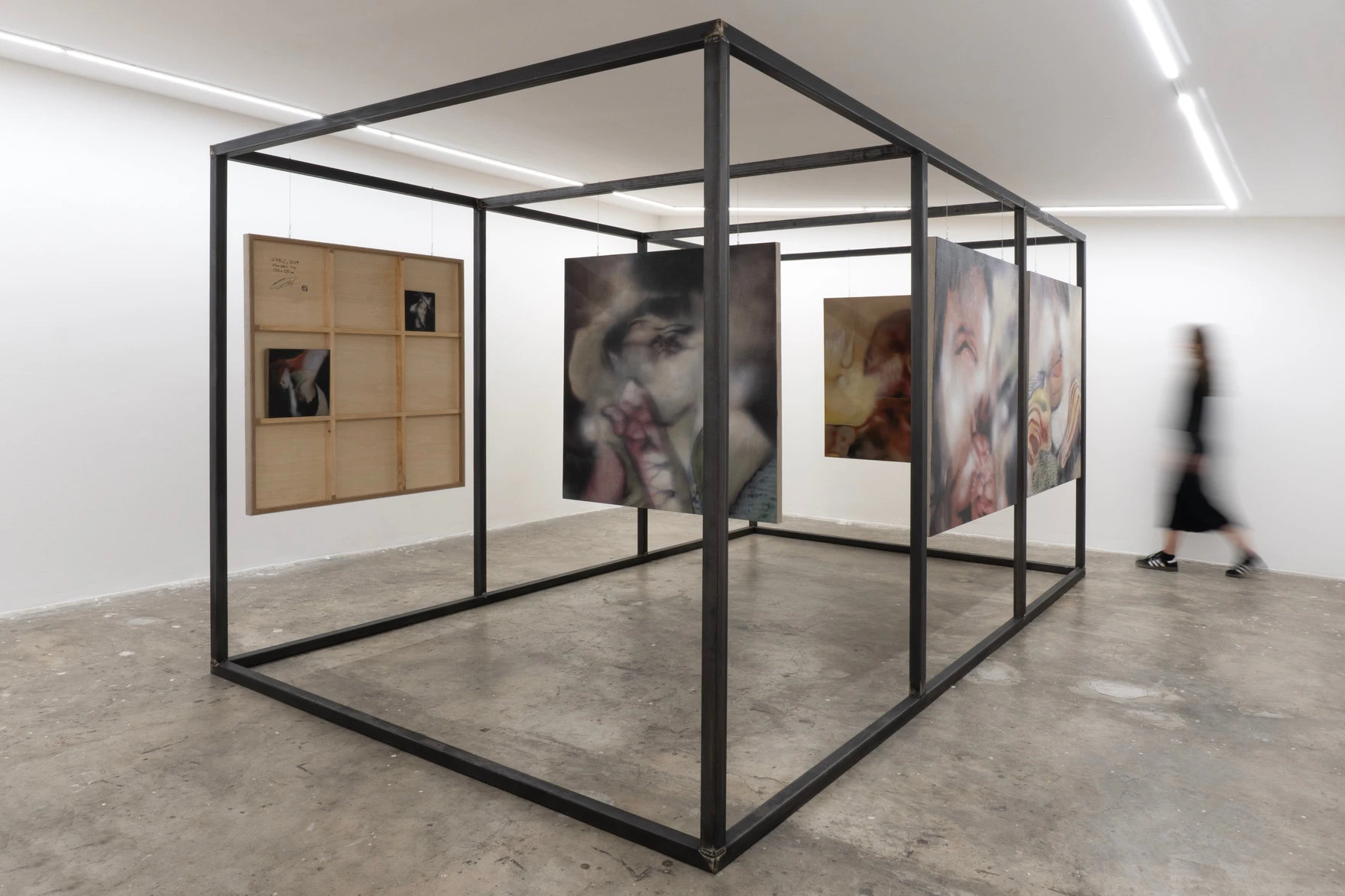
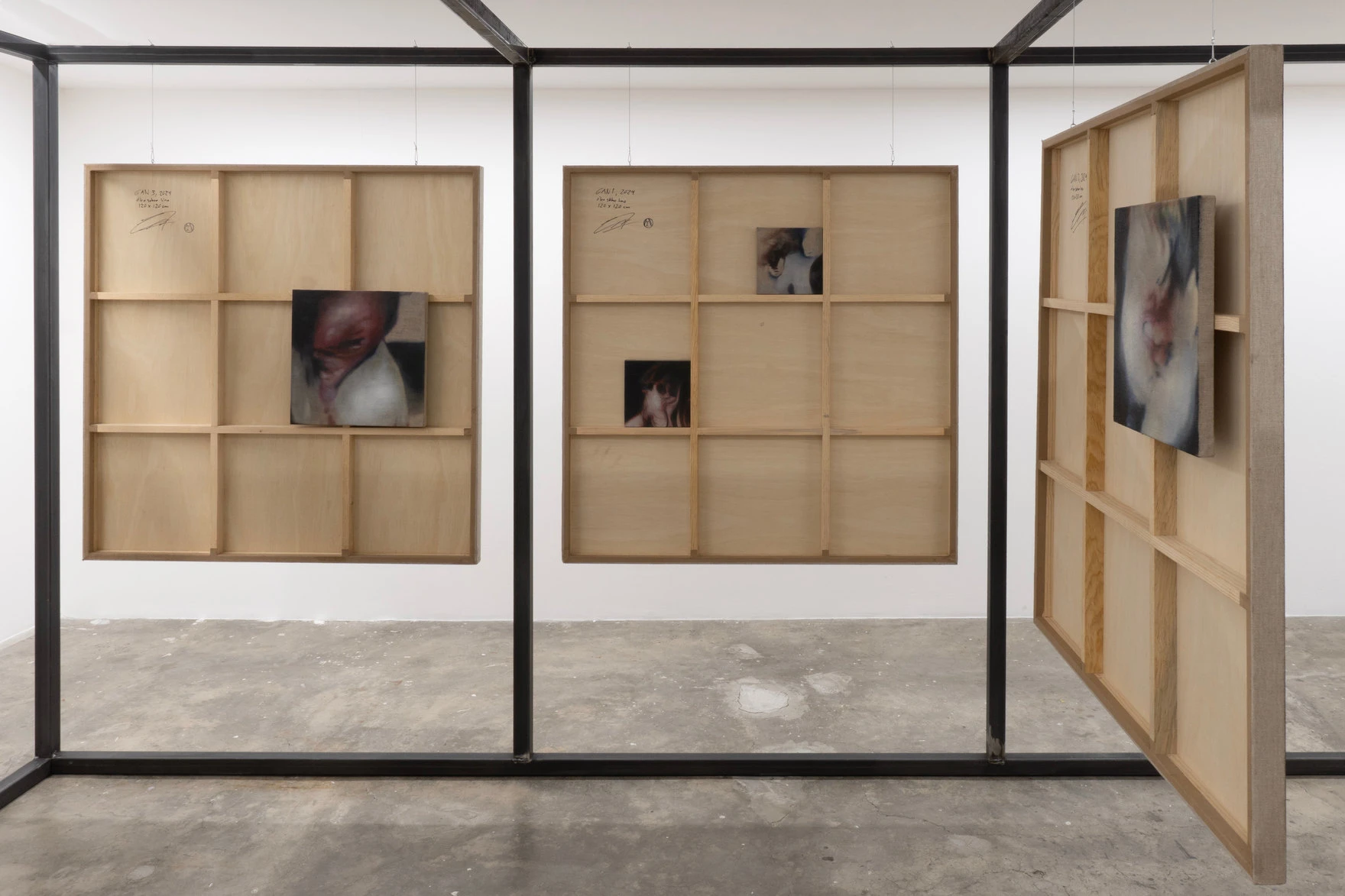
Ángela LeyvaIn Encarnación, I wanted the paintings to stop depending on the wall. The cubic structure grew out of an idea of containment that runs through the different phases of the project, but here the cube opens up and exposes its interior. It ceases to be an enclosure and becomes a structure that lets you move among the paintings and see them from different positions.
Suspending a painting makes something obvious that we often overlook when we see it head-on: its existence as an object. You can see its dimensions, edges and thickness, as well as its relationship to the other paintings and to the empty spaces between them.
I wanted the installation to leave room for more than one reading. As you move, the relationships between the works change and you have to keep adjusting your position. A frontal photograph can record the painted surface, but it can’t give you the experience of how scale, distance and the path you take relate to one another.
Your work begins with clinical archives. Where do you draw the line between an image you can transform and one you choose to leave untouched? We’re interested in your decisions about care, context and what should remain out of view.
Ángela LeyvaMy research begins with a clinical archive assembled by my father, a medical geneticist. It contains photographs of patients with congenital conditions. Since Bilis Negra, I’ve worked with these images through painting, shifting them from their documentary function into a pictorial context.
One decision I’ve made is to keep the identities of the people pictured and their medical histories out of the work. I don’t want to reconstruct their biographies or make their medical conditions the focus of the image.
In Máquinas que sueñan niños, I brought my archive of paintings together with the clinical archive. I wanted the images I had already interpreted in paint to encounter the photographs they came from again.
Transforming an image doesn’t in itself resolve the ethical questions that come with the archive. Where I draw the line also has to do with how an image circulates, the context in which it appears and what I feel needs to stay out of view. Not everything an archive holds needs to be made visible.
You’ve acknowledged Fabiola Larios’s contribution to training the models used in Máquinas que sueñan niños. Was there a decision you made together during training or image selection that changed the way you understood the project?
Ángela LeyvaMy collaboration with Fabiola Larios was important in the early stages of this research, when we developed a method for bringing two different kinds of archives together. We worked with Dataset A, which contained photographs from the clinical archive, and Dataset B, which contained paintings from Bilis Negra. Dataset AB emerged from that process.
One of the central decisions was to include my earlier paintings in the process of generating new images. This allowed us to establish a relationship between the documentary archive and the paintings I’d made from it over a number of years.
My collaboration with Fabiola focused on this stage of development and image generation. After that, I worked independently with the resulting material, which I began to think of as a set of sketches. I then selected images to guide my painting, paying attention to the possibilities each one offered when I took it onto canvas.
In LIMO, visitors took part physically through water. In Encarnación, the experience takes shape through suspended paintings and an open structure. How has your understanding of the visitor’s bodily encounter with painting changed between the two exhibitions?
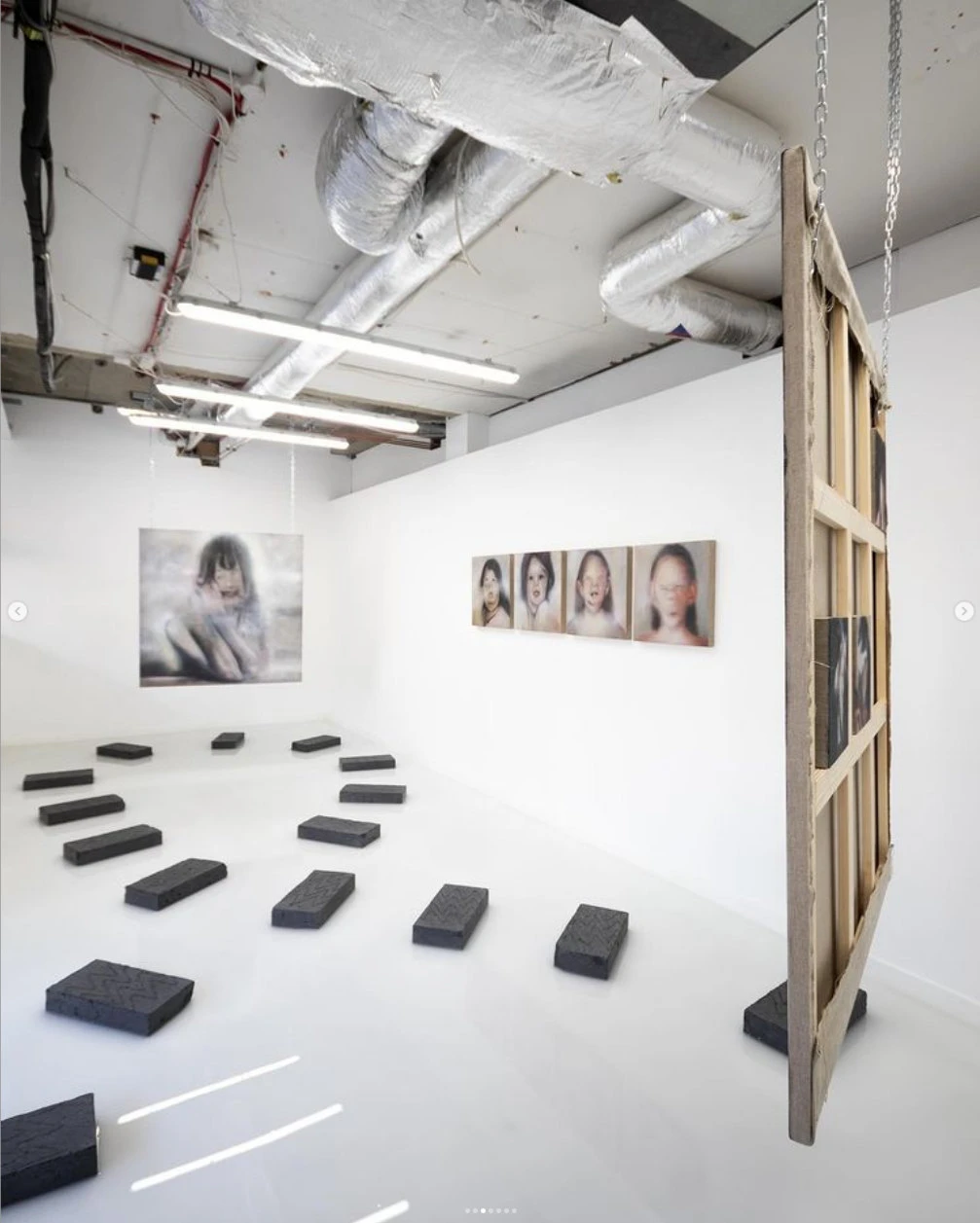
Ángela LeyvaIn LIMO, I worked with two elements, ether and light. Their interaction gave rise to LIMO, a substance in constant metamorphosis. Impregnation, distortion and overflow were part of my investigation into how the bodies I depicted changed and lost their stability.
The installation brought some of these concerns into the visitor’s route through the space. The floor was covered with a white, almost amniotic liquid. To cross it, you had to walk along a series of bricks that formed a bridge. The water kept you from moving freely and made you follow a set path. I wanted to give you the sense of coming upon a space of gestation, almost as if you were standing before an embryo.
In Encarnación, the bodily encounter happens differently. The paintings appear directly in front of you, suspended in an open structure. There is no longer a liquid surface determining where you can go. The arrangement of the works establishes the distances, how close you can get, and the visual relationships.
In LIMO, the route kept you in front of something that seemed to be gestating. In Encarnación, you had to confront something that had already taken material form. I’m interested in the difference between approaching something that is still held inside and encountering a painting whose physical existence you can no longer avoid.
Encarnación was presented as the third phase of Máquinas que sueñan niños. What remains unresolved after this phase, and what are you making now?
Ángela LeyvaI conceived Máquinas que sueñan niños in three phases. They correspond to different states of the image and of matter, and don’t necessarily follow a chronological sequence.
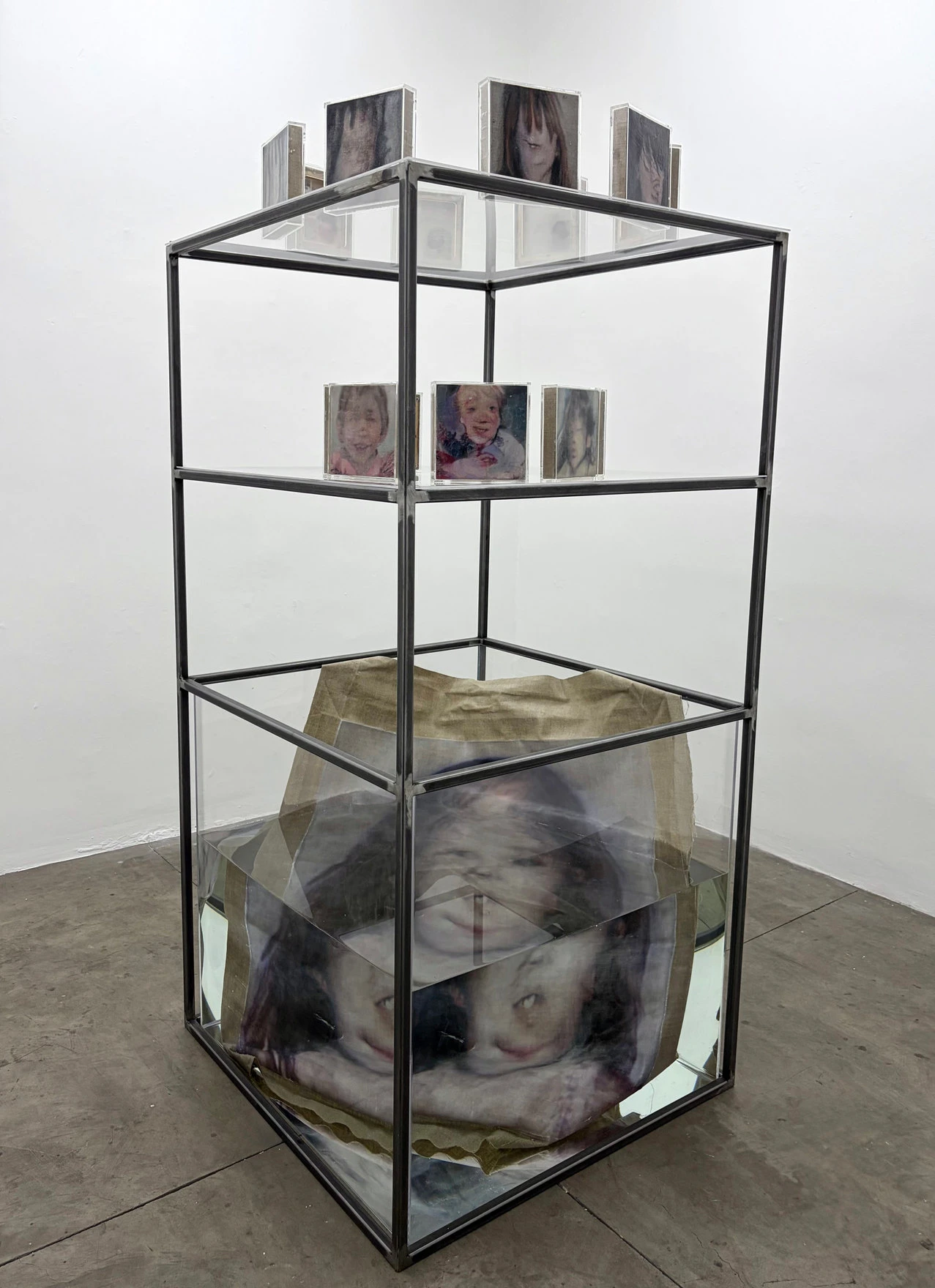
In F1: Umbral AB, presented at CROMA, I built a cryosleep capsule that served as an incubation space. The paintings appeared as hybrid organisms undergoing gestation and mutation, held within acrylic structures and wax membranes.
In F2: Latencia, which I presented at Material Art Fair 2026 with my project CROMA, I used wax to cover the entire surface of the paintings. I wanted this layer to act as a kind of epithelium, a temporary skin that protected and veiled the image. The paintings were in a state close to birth: something was beginning to show, though it still lay beneath a membrane.
Finally, in F3: Encarnación, presented at CURRO, the paintings left those isolating structures and appeared suspended inside an open cube. The image took on a singular, finite pictorial form in a particular place. For me, to become embodied didn’t mean becoming human. It meant accepting a limit as the condition for appearing at all.
This third phase brings the project’s conceptual structure to a close, but the questions that first gave rise to my research remain. My work is now moving from the bodily towards the atmospheric. I’m continuing to explore glazing, erasure and the loss of definition in the portrait.
In Encarnación, I was interested in how an image could acquire a body through painting. Now I wonder what happens when that sense of having a body begins to come apart, when the portrait no longer asserts itself as a recognisable form and begins to approach a state of atmosphere.