Kaja Clara Joo
What Must Remain Alone
On changing Polaroids, the weight of an unpaired image, and the autonomy of a work.
Read the conversation
In Joo’s account, rain entered the Seoul exhibition where Wounds was shown. Its steel frames oxidised while the Polaroids continued to change. In All These Dwellings Are Temporary, made during a residency in Texas, she describes leaving footage of mourning without a companion image: a deliberate refusal of the split screen’s usual logic. In Bulgasari Manual (Drifter), the line between North and South Korea becomes a cut in brass, marked with her own tears. Moving between photography, sculpture and film, Joo considers what an image might be allowed to do before an artist, an institution or an explanation decides it is finished. The following conversation follows those decisions from the material surface to the politics of looking.
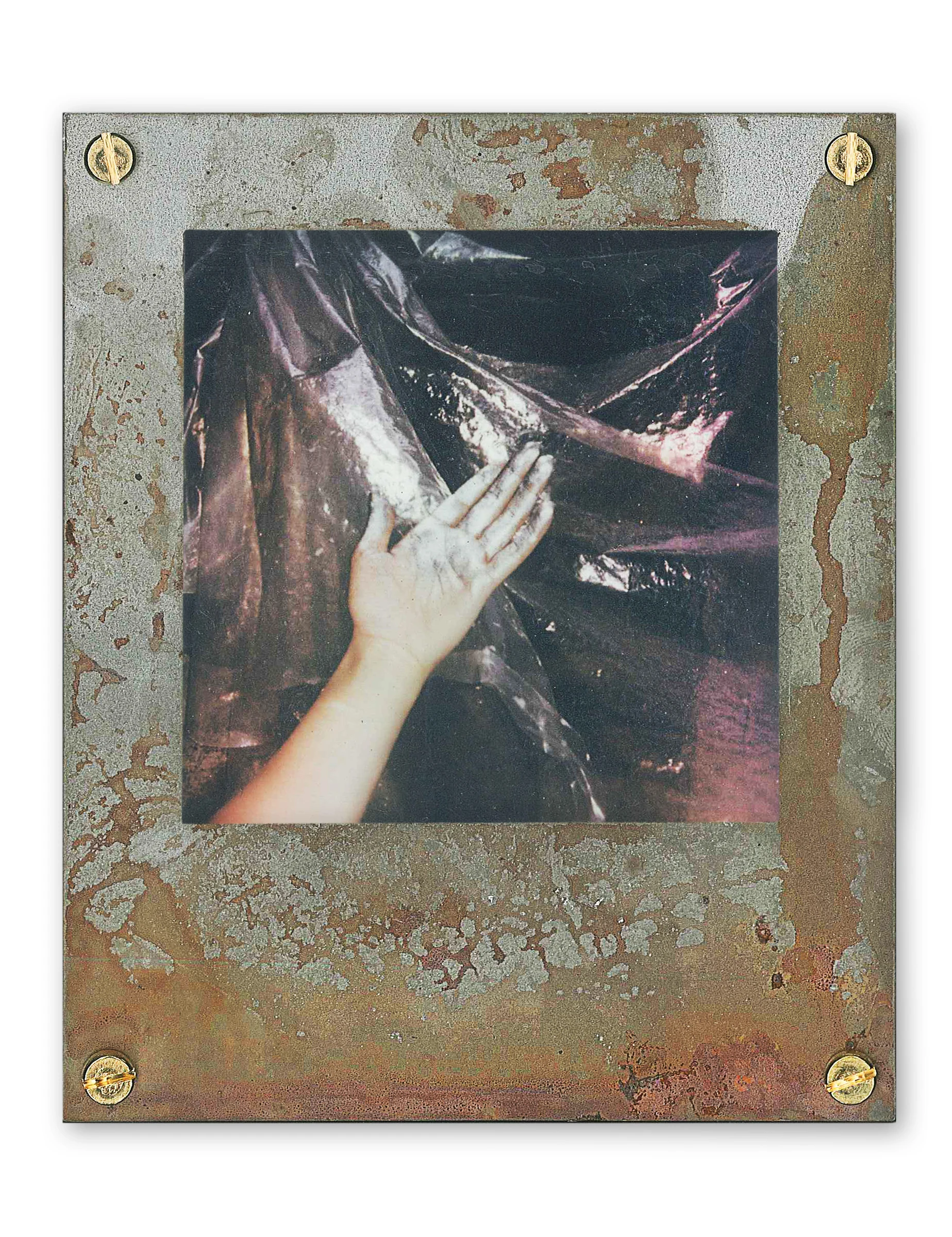
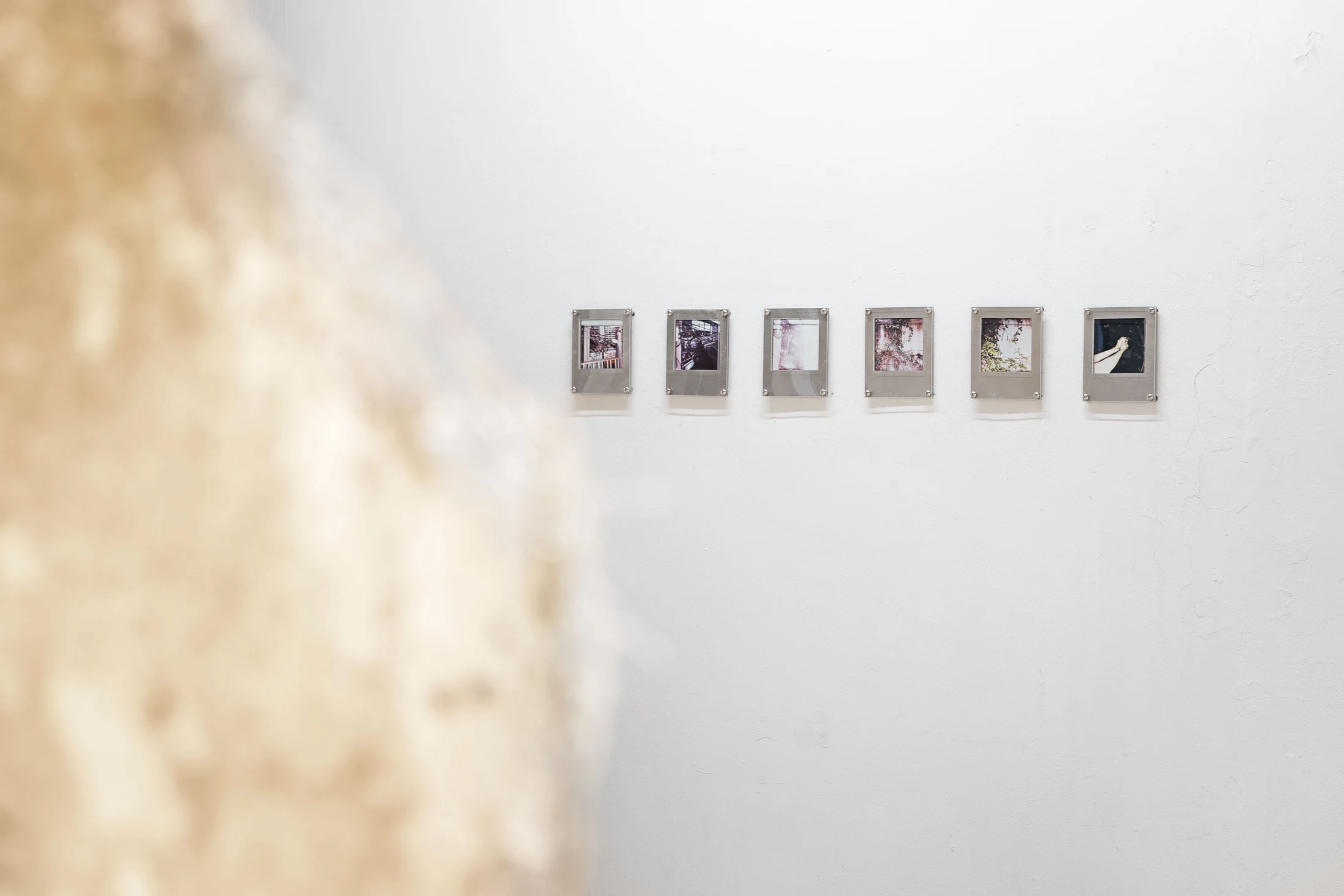
Wounds brings Polaroid photographs together with nitric acid and articulated metal frames. What are you looking for at the moment you decide to stop altering a photograph? Is there something the image must still be able to hold?
Kaja Clara JooWounds was created and exhibited in Seoul, where rain entered the exhibition space. As water trickled down the walls, the steel frames began to oxidize. There was a strange parallel between these components. One of the things I find so alluring about Polaroids is their short shelf life and inherent instability: even after the image has appeared, chemical processes continue for several weeks. I liked that the photographs were exhibited in this vulnerable state, almost as if they were still in the midst of being born.
The pictures depict fragments of a fast-moving city: exposed high-voltage cables dangling within arm’s reach in public space, resembling an Ouroboros devouring itself. Or the last bloom of a hummingbird vine that had somehow escaped being torn down by municipal gardeners in a public park. Its pollen hanging low, as if ready to birth new kindlings in protest. They are incidental scenes of everyday life that carry a friction between life and death. The following month I brought them to Switzerland. When I unpacked them, the bag had already turned powdery orange from the oxidizing steel and the nitric acid. It felt like uncovering brittle petals that had just stopped drying. I never consciously put a time stamp on when a picture needs to be stopped from transforming. They need to ripen on their own.
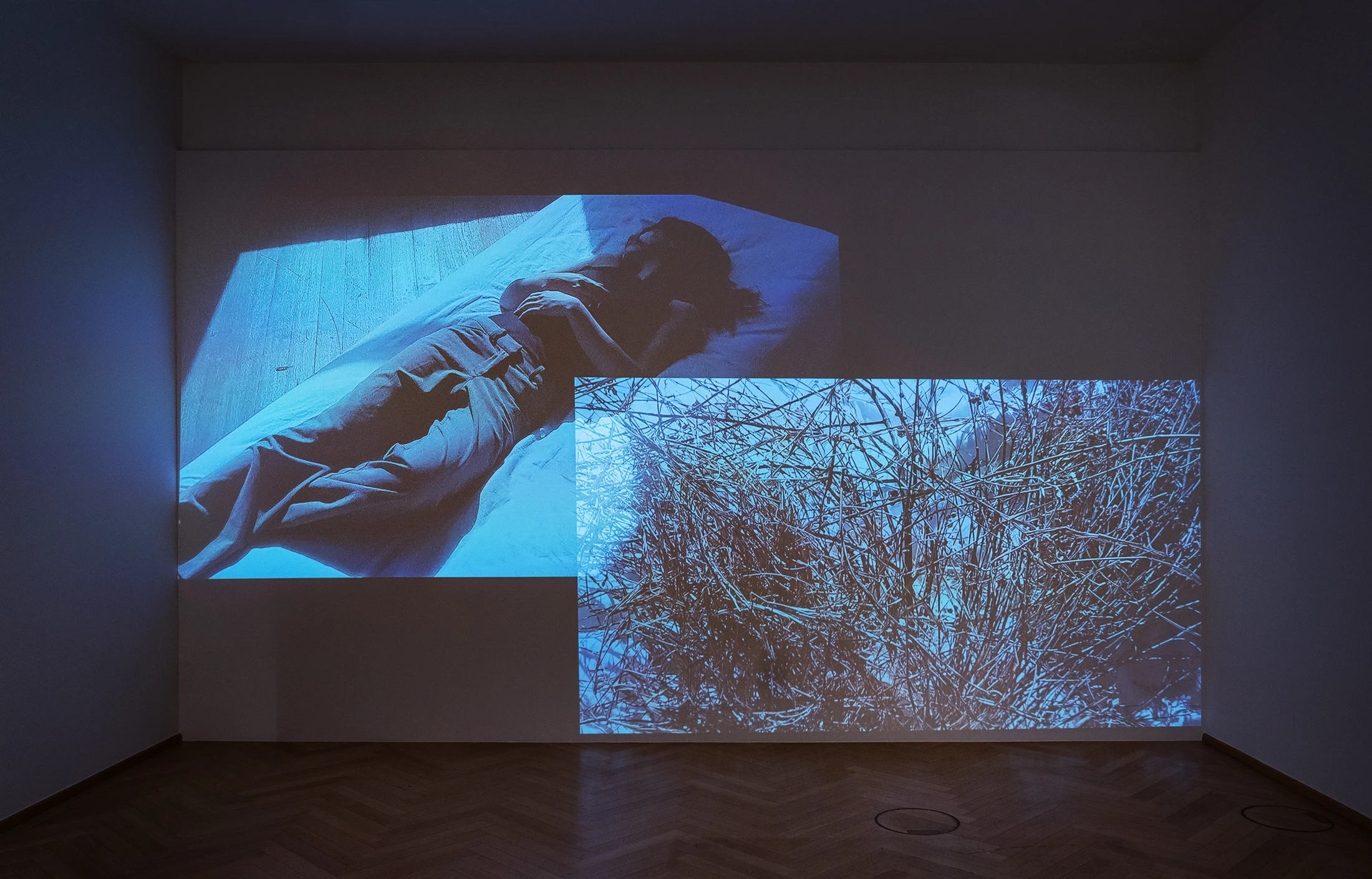
All These Dwellings Are Temporary places life in Corsicana beside footage of protests in Iran and demonstrations against ICE. How did you choose what must not be placed beside what? Could you describe one cut or juxtaposition you rejected?
Kaja Clara JooIt was less a question of deciding what should not be placed together than of recognising what needed to be placed in solitude, in no constellation with a second frame, as anything else would inevitably interfere with its own internal weight. I was undertaking a residency in Corsicana when I began working on the film. It developed as a form of media analysis of different televised realities I was moving between: Austrian, Korean and American news broadcasts.
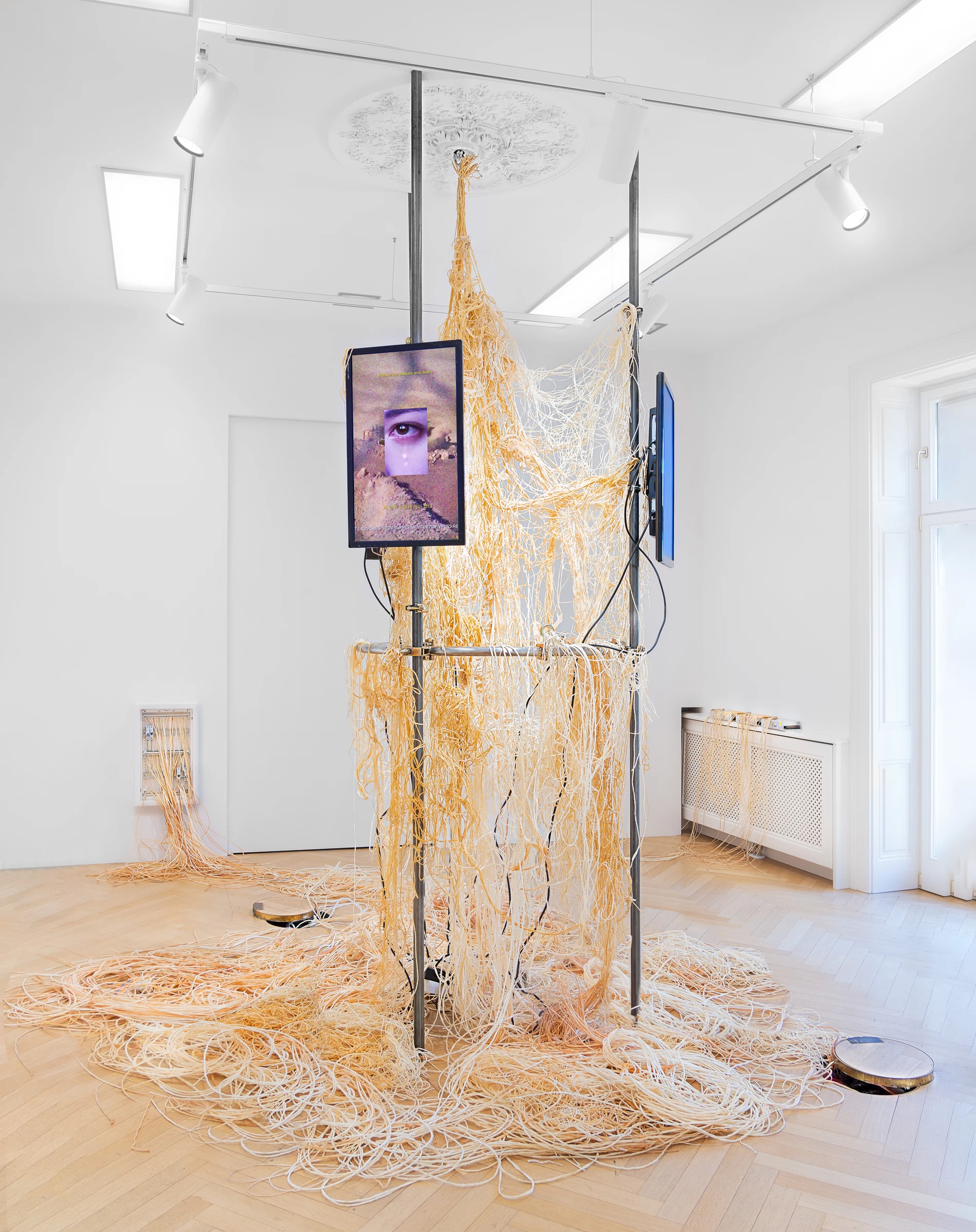
There is a moment in the film when one of the screens folds into black, leaving only the footage of a family mourning their son, who was killed during the protests in Iran. The mother is dancing, her face contorting with grief, while the father is paralleling her. Their movements are extraordinarily gentle, they raise their arms towards the sky and then towards each other. It is a mourning dance, referred to as raqs-e marg (رقص), that became a visible gesture of defiance during these protests. By dancing publicly at funerals people reclaimed bodily expression in the face of a regime that seeks to violate them. There is something profoundly difficult about watching it: the unbearable proximity of grief, beauty and devastation: gestures that exceed national borders and languages.
In your KUNZTEN interview you described yourself as a photographer first. In a recent installation, where does the photographic act happen: in making an image, selecting it, exposing a surface, or arranging a viewer’s position? Please take us to one specific moment.
Kaja Clara JooJohn Berger writes that “A photograph is static because it has stopped time. A drawing or painting is static because it encompasses time.”
Something similar happens to my perception in an installative context, although I have increasingly found myself thinking less in terms of creating a distinction between photography and sculpture. I tend to see them as part of creating a similar condition. What interests me is the possibility of creating circumstances in which our habitual sense of chronology is suspended. Not so much a stopping of time as an experience of simultaneity, in which different moments coexist. Even in works where temporality becomes visible (through processes such as oxidation, for instance) I am interested in something beyond the mere passage of time: the presence of different temporal states within the same moment. Just like Berger described within the spheres of painting.
In Bulgasari Manual (Drifter), cartographic forms and oxidation occupy the same object. How does assembling or separating the parts change the way the border can be read?
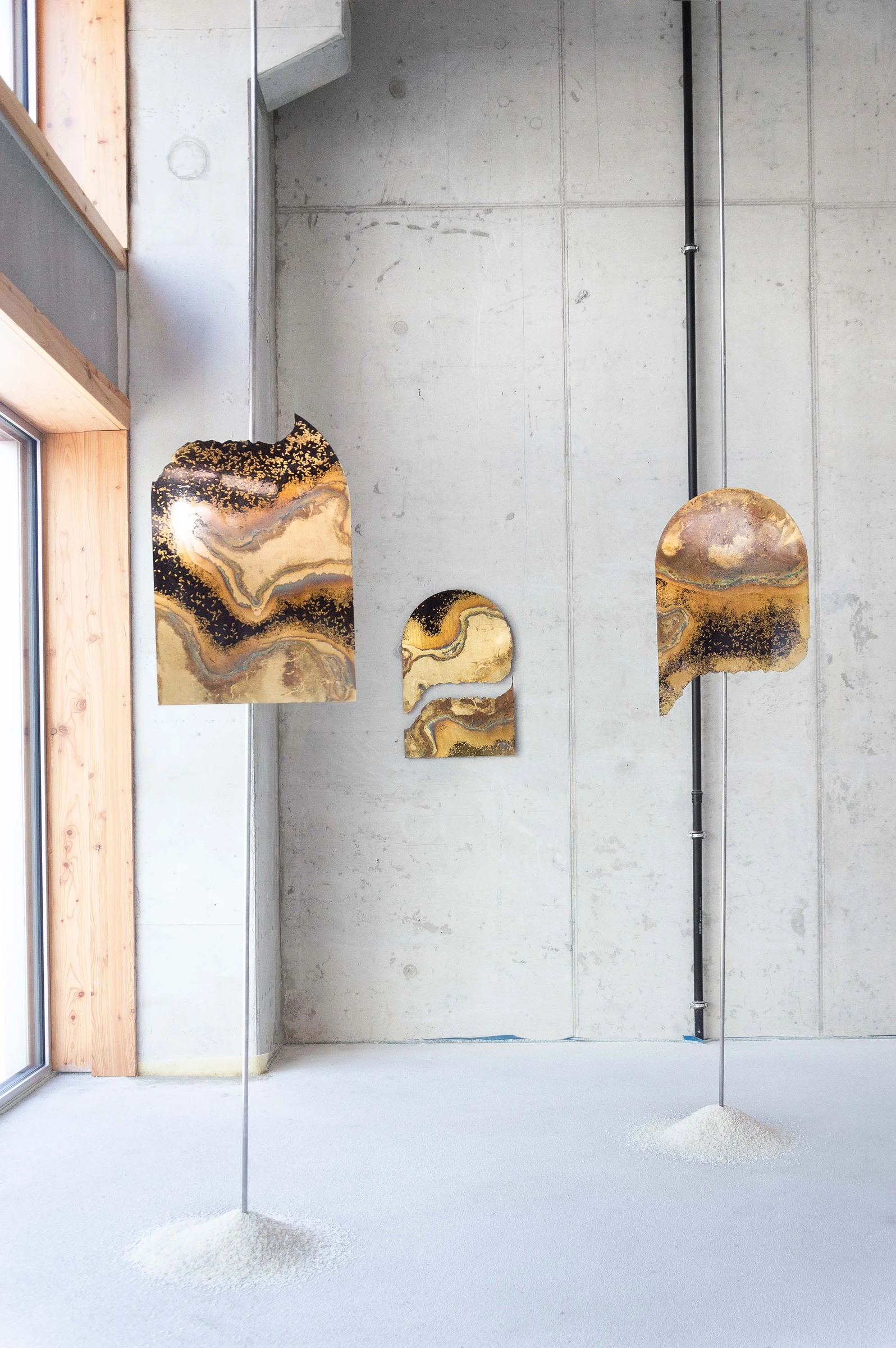
Kaja Clara JooI laser-cut the demilitarized line separating North and South Korea into brass plates, which were then stained using my own tears. The work focused on a mythological creature called Bulgasari that feeds on metal. The legend was adapted into the North Korean monster film Pulgasari, directed by South Korean filmmaker Shin Sang-ok, who had been abducted in 1978. Actress Choi Eun-hee had also been abducted that year. Both escaped during a trip to Vienna in 1986. I was interested in this rather forced entanglement between the North and South. The border continues to divide two territories whose relationship and respective understandings of one another have drifted apart. It is as if one is witnessing a phenomenon of geographical phantom pain: the sensation of a limb that has long been amputated, yet whose absence continues to be present. The border, in this sense, marks not only a division but the phantom of a former connection. Not everything that was torn apart calls for reunification.
When a viewer does not recognise the history or source behind a work, what would you still want the encounter to make possible? Is there a piece for which explaining too much would close something down?
Kaja Clara JooI intensely hold on to the belief that a work needs to inhabit the quality to allure a viewer into looking, even without any formal introduction through text or other sources of information. Those qualities may vary and also depend on a viewer’s willingness of engagement.
I still have an infuriating impulse to over-explain what I do, perhaps because this is how classic academic education teaches young artists to express (or better said: justify) themselves. But I have just recently learned to trust the poetic qualities of a work first. Certain moments can create a pull, a lusting and a longing. Or how they say: “Come-hither look”!* It cannot be deconstructed, only felt as it unfolds in front of you. Maybe these are inherently animistic properties of a work itself: an autonomy to gaze back at the viewer while gently licking its lips as they step closer.
*The expression “come-hither look” emerged around the turn of the 20th century and became popular in the first half of the century, often describing the seductive, inviting gaze of classic film stars in romantic cinema, where desire was frequently conveyed indirectly rather than explicitly.
What has changed in your practice since the work made in Texas and the recent projects in Korea and Austria? Please choose one current experiment that points towards your next project, and share any confirmed plans that can be announced.
Kaja Clara JooThese past months I was thrown in a swirl of emotions: I came to Korea to research lost family heritage during the times of Japanese colonial rule. Speaking to people who survived war whilst browsing through an endless stream of old photographs in the National library had left a mark on me. Like unknown corpuses my own family history washed ashore my own alertness. I arrived to Texas during the height of the ICE demonstrations directly afterwards. I have never encountered so many voices of resistance in the art scene like I did in the US: Urgency creates defiance, or so I presumed. As I returned home I was left in a peculiar state between euphoria and dejection that I am yet unable to articulate. My works have become somewhat softer, yet more vicious.
I was recently awarded a studio by the Federal Ministry of Culture in Austria, a place bigger than my apartment. Although my practice often involves large-scale sculptures, I started to find myself drawn to immaterial physicalities, like oral narrations. My grandparents told me that children growing up in post-war times would lick the walls of buildings as the plaster contained lime. There are no written historical accounts of this information, but it persists as a collective, inherited knowledge. Bodies that know what they need, even in the debris of a post-war city.
My next solo will take place at the Changdong Residency at the National Museum of Modern and Contemporary Art in Korea in June 2027. I am unsure how the experiences of these past months will form me artistically in the future. Perhaps creating art in times of turmoil might demand new forms of summoning valor: To stay tenacious yet tender, in spite of disaster ahead.